| 0800 – 1700 |
Registration Open
Mezzanine Level, Hotel Grand Chancellor Hobart |
|
PLENARY SESSION
Grand Ballroom, Hotel Grand Chancellor Hobart |
| 0850 – 0905 |
Welcome to Day 2
Platinum Sponsor Address: Wilderlab |
| 0905 – 0935 |
Keynote Presentation
Leaving the lab behind: a vision for eDNA/eRNA technologies
Jo-Ann Stanton
Presentation sponsored by Cawthron |
| 0935 – 1005 |
Keynote Presentation
ANEMONE: The eDNA Monitoring Network in Japan
Michio Kondoh
Presentation sponsored by Illumina |
| 1005 – 1035 |
MORNING TEA & EXHIBITION
Mezzanine Level, Hotel Grand Chancellor Hobart |
| 1035 – 1135 |
CONCURRENT SESSIONS |
|
Concurrent Session 10
Technical innovation
Grand Ballroom 1 |
Concurrent Session 11
Biosecurity & Monitoring
Grand Ballroom 2 |
Concurrent Session 12
Bioinformatics, analysis and visualisation
Grand Ballroom 3 |
| Session Chair |
Mark Wallace |
Katrina West |
Jo Ann Stanton |
| 1035 – 1050 |
Filter no more: A modified plankton sampler for rapid in-water eDNA capture
Xavier Pochon |
Using eDNA to detect nutrient enrichment in estuaries
Anastasija Zaiko |
Variational auto-encoder applied to eDNA outperforms traditional methods
Letizia Lamperti (via video link) |
| 1050 – 1105 |
The complex effects of time, ambient temperature and UV intensity on vertebrate eDNA degradation in soil
Austin Guthrie |
Wastewater as a rich source of DNA/RNA for community infectious disease surveillance
Joanne Chapman |
WoMBot: Workflow for processing MetaBarcoding eDNA data from reads to significance calls on maps of spatio-temporal species distributions
Nenad Bartonicek |
| 1105 – 1120 |
Splat That Scat To Find The Bat
Dr Rachael Impey |
A targeted eDNA approach to detect and quantify Undaria pinnatifida
Jonika Edgecombe (via video link) |
Optimising eDNA sampling strategies for improved detection likelihoods using biophysical models
Eric Treml |
| 1120 – 1135 |
Developing new tools for invasive ant detection: a novel eDNA assay for yellow crazy ant detection in soil and water
Dr Natalia Andrade Rodriguez (via video link) |
Environmental DNA biosurveillance of chelonid herpesvirus 5 (ChHV5) in Singapore’s endangered sea turtle populations
Dr Aden Ip |
eDNA monitoring design for robust impact attribution
Dr Levente Bodrossy |
| 1135 – 1140 |
QUICK BREAK – 5 minutes |
| 1140 – 1310 |
CONCURRENT SESSIONS |
|
Concurrent Session 13
Technical innovation
Grand Ballroom 1 |
Concurrent Session 14
Novel applications and environments
Grand Ballroom 2 |
Concurrent Session 15
Biosecurity & Monitoring
Grand Ballroom 3 |
| Session Chair |
Lev Bodrossy |
Anthony Chariton |
Cecilia Villacorta-Rath |
| 1140 – 1155 |
Maximizing passive eDNA collection using varied membrane materials
Dr Cindy Bessey |
Metabarcoding of seawater environmental DNA reveals strong differentiation of coral reef communities across habitats
Laurence Dugal (via video link) |
Comparing eDNA metabarcoding and morphology-based surveys for environmental monitoring of aquaculture enriched soft sediments
Alex Coutts |
| 1155 – 1210 |
Improved yield and sensitivity of eDNA in riverine environments through overnight passive sampling
Shaun Wilkinson |
Community shifts at volcanic CO2 seeps, an eDNA prospective
Michael Izumiyama |
Modelling approaches to quantify operational performance and interpret results of molecular surveys
Kathryn Wiltshire |
| 1210 – 1225 |
Biodiversity monitoring through environmental DNA obtained from filter-feeding organisms
Dr Gert-Jan Jeunen (via video link) |
Detection of a marine to terrestrial transition in lake sediment from Baffin Island, Arctic Canada, using sedimentary DNA
Matthew Power |
How environmental DNA survey methods are informing management of waterways across Greater Melbourne: from long-term research to routine application
Dr Rhys Coleman |
| 1225 – 1240 |
Biodiversity on the fly: Carrion fly iDNA metabarcoding to monitor mammals in a fragmented terrestrial ecosystem
Kristen Fernandes (via video link) |
Use of eDNA to understand spatiotemporal variability in phytoplankton diversity available as potential food for Crown-of-Thorns Seastar larvae in the Great Barrier Reef
Maria Gomez Cabrera |
Comparing traditional and DNA-based methods for deriving river health indices
Dr Michael Shackleton |
| 1240 – 1245 |
eDNA detection of a cryptic insect species using a novel collection technique in crops
Dianne Gleeson |
Environmental DNA needs reference data for taxonomy-based conservation policy – A case study from Fiordland, New Zealand
Dr Paul Czechowski (via video link) |
Lightning Presentations |
| Environmental DNA detection of the giant freshwater crayfish (Astacopsis gouldi)
Dr Alejandro Trujillo-González |
| 1245 – 1250 |
Assessing genomics approaches for monitoring terrestrial invertebrate bioindicators for ecosystem restoration
Allyson Malpartida |
| 1250 – 1255 |
Tracking the iconic Giant Triton snail on the Great Barrier Reef
Merle Schlawinsky |
| 1255 – 1300 |
You can’t detect it if you don’t collect it: optimising eDNA sample collection techniques
Sebastian Mynott (via video link) |
Lightning Presentations |
Biomonitoring of freshwater streams using bulk eDNA and CRISPR-Cas enrichment
Anya Kardailsky (via video link)
|
| The conundrum of related taxa: Detection and authentication of pathogen DNA in bioarchaeological samples from the Pacific
Meriam Van Os (via video link) |
| 1300 – 1305 |
Characterising biodiversity in two deep-sea canyons in Western Australia
Georgia Nester |
|
| 1305 – 1310 |
|
|
| 1310 – 1400 |
LUNCH & EXHIBITION
Mezzanine Level, Hotel Grand Chancellor Hobart |
| 1400 – 1530 |
CONCURRENT SESSIONS |
| |
Concurrent Session 16
Technical innovation
Grand Ballroom 1 |
Concurrent Session 17
Bioinformatics, analysis and visualisation
Grand Ballroom 2 |
Concurrent Session 18
Diet and trophic interactions
Grand Ballroom 3 |
| Session Chair |
Clare I. M. Adams |
Shane Herbert |
Craig Sherman |
| 1400 – 1415 |
Investigating environmental DNA & RNA fate for biosecurity applications: A case study using the Mediterranean fanworm Sabella spallanzanii
Michelle Scriver |
Free from the tyranny of taxonomy: a robust taxon-independent community index (TICI) for riverine ecological assessment
Dr Shaun Wilkinson |
Using eDNA technologies to understand trophic interactions supporting white shark populations
Jess Fish |
| 1415 – 1430 |
Antarctic krill (Euphausia superba) eDNA quantification and decay characteristics.
Dr Leonie Suter |
Looking under the mat: benchmarking computational methods for analysing microbial datasets
Dr Matthew Campbell |
Experimental evidence that the topological features of microbial co-occurrence networks respond to stressors
Dr Anthony Chariton |
| 1430 – 1445 |
A new marine genomics initiative to aid research and conservation efforts
Priscila Goncalves |
eDNAFlow, an automated, reproducible and scalable workflow for analysis of environmental DNA sequences exploiting Nextflow and Singularity
Dr Mahsa Mousavi |
Can environmental DNA to be used to study adaptive diversification in aquatic systems? – A test case using the Lake Masoko Astatotilapia calliptera study system.
Zifang Liu (via video link) |
| 1445 – 1500 |
Establishing Filter Feeding Organisms as Ecological Sentinels
Michelle Liddy (via video link) |
Towards the standardisation of bioinformatic eDNA workflows for ocean conservation: Considerations and best practice for robust amplicon data analysis
Sebastian Rauschert |
|
1500 – 1505
|
Full Length Oxford Nanopore 16S rRNA Amplicon Sequencing of Contaminated Drinking Water
William Taylor |
Visualising gaps, overlaps and anomalies in taxonomic reference data for metabarcoding
Dr Annette McGrath (via video link) |
Lightning Presentations |
| Using metabarcoding to identify threats to key trophic interactions supporting a commercial fishery in a climate change hotspot
Owen Holland |
| 1505 – 1510 |
The importance of denitrification in oyster biofilm
Giulia Filippini (via video link) |
| 1510 – 1515 |
Environmental DNA as a tool to assess groundwater Microbial communities in response to salinisation
Tess Nelson |
| 1515 – 1520 |
Keeping eDNA research out of the Trough of Disillusionment
Simon Jarman
|
Macroinvertebrate biomonitoring in tropical environments using next generation sequencing technologies
Dr Thomas Mooney
|
Identifying indicators of soil nutrient cycling on a restored mine site
Kate Montgomery |
| 1520 – 1525 |
|
| 1525 – 1530 |
|
| 1530 – 1600 |
AFTERNOON TEA & EXHIBITION
Mezzanine Level, Hotel Grand Chancellor Hobart |
| 1600 – 1700 |
CONCURRENT SESSIONS |
| |
Concurrent Session 19
Technical innovation
Grand Ballroom 1 |
Concurrent Session 20
Biodiversity, Biogeography & Distributions
Grand Ballroom 2 |
Concurrent Session 21
Biosecurity and monitoring
Grand Ballroom 3 |
| Session Chair |
Mahsa Mousavi Mousaviderazmahalleh |
Rachel Hale |
Morgan Ellis |
| 1600 – 1615 |
Comparing eDNA collection methods for sampling community composition on marine infrastructure
Jason Alexander |
A comprehensive eDNA metabarcoding survey of gelatinous zooplankton biodiversity in a changing Arctic
Ayla Murray |
Assessing the reliability of eDNA as a tool for invasive non-native species and biodiversity monitoring in freshwater ecosystems
Jo James |
| 1615 – 1630 |
Nanopore short-read sequencing: A quick, cost-effective and accurate method for DNA metabarcoding
Dr Aimee Van Der Reis |
|
Towards understanding the liver fluke transmission dynamics on farms: detection of liver fluke transmitting snail and liver fluke-specific eDNA
Travis Beddoe |
| 1630 – 1645 |
Rapid diagnostic of eDNA in environmental water
Meysam Khodaparast |
Marine biodiversity patterns in an anthropogenically impacted oceanic archipelago: The first eDNA survey of the Ogasawara Islands
Ayse Haruka Oshima Acikbas |
Environmental DNA monitoring and ecosystem resilience in the Murray Darling Basin
Dr Chris Hardy |
| 1645 – 1700 |
Optimising detection of invasive marine species by characterising eDNA particle size
Kate Tuohey |
Detecting cryptic terrestrial species in targeted eDNA sampling
Dr Joel Huey |
|
| 1900 – 2300 |
2023 eDNA Conference Dinner
In The Hanging Garden, 112 Murray Street, Hobart
Join your fellow conference delegates for a night of networking and celebrations at the 2023 eDNA Conference Summit Dinner. The dinner will be held at one of Hobart’s most popular venues, In The Hanging Garden. The dinner will showcase local produce served as canapes, grazing stations and, also feature live cooking stations. The cocktail style event will ensure there are plenty of networking opportunities but don’t worry, we will ensure there is plenty of food and seating! 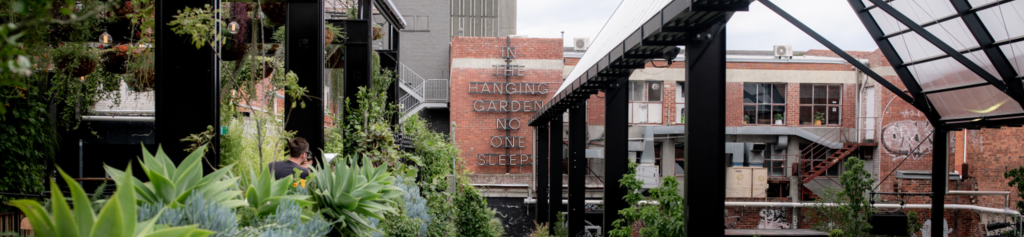 |